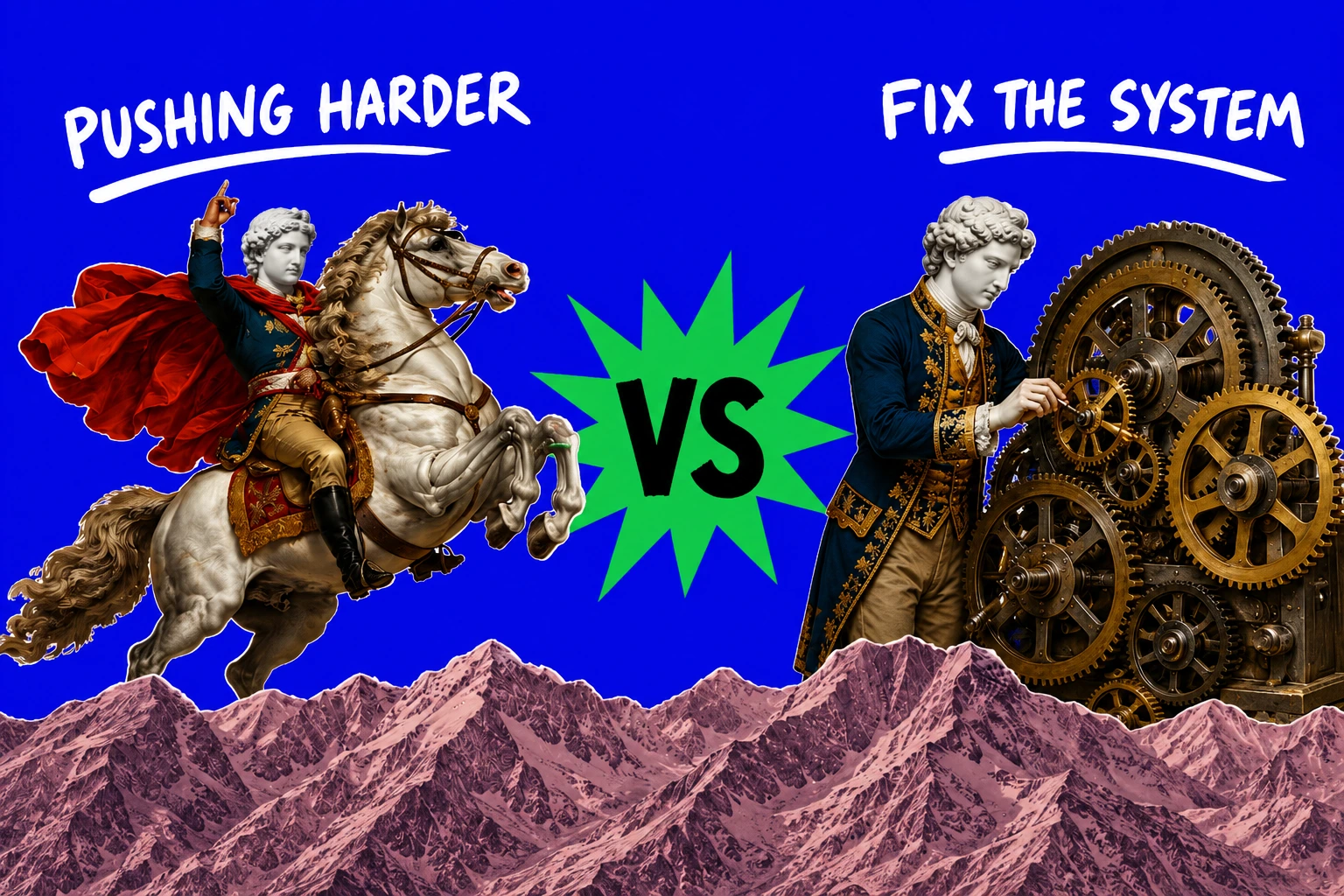

When growth flattens, the first suspect is always the product. Maybe it needs more features, or the segment is wrong, or the pricing should be rebuilt and the integration everyone keeps asking for finally shipped. So the team pours another quarter into the thing that used to work, and the line stays flat.
The data is not kind to the product theory. McKinsey's research suggests around 78% of companies that find product-market fit still fail to scale from it. And when investors run the autopsy on their own portfolio companies, they pin roughly two-thirds of the deaths on people and organisation, not the product and not the market. You are debugging the one part of the system that mostly works.
A real plateau is confusing because nothing obvious is wrong. The product still works. Customers still renew. The market still wants what you sell. You are just slower. Initiatives that would have taken three weeks take three months. Decisions one person used to make now need four people in a room, and the room's main output is scheduling the next room.
That confusion is the tell. If the product were the problem, you would see it in the product: churn, failed demos, a competitor eating your lunch on features. When the slowdown shows up as friction instead of rejection, you are not looking at a market problem. You are looking at an organisational one.
Early growth runs on a quiet engine nobody documents: the founder, plus a handful of people who carry the whole company in their heads. They know why the priorities are the priorities. They know who to ask. They make the call in the hallway and everyone moves.
That engine is astonishingly effective at twelve people. At sixty, it quietly becomes the bottleneck. You have scaled the headcount, the office, and the AWS bill, and somehow skipped the one thing that mattered: the ability to make a decision without you in the room. The founder is now the single point of failure for every call that counts. It looks like a control issue. Usually it is a dependency issue. Nobody ever rebuilt the operating system for people who don't have the founder's context, because for years there was no reason to.
So the work doesn't stop. It routes back through the same few people, and those people are now underwater.
The standard move at this point is to hire. More senior people, more specialists, a VP to "own" the broken function. It feels like progress because the org chart gets bigger.
You added thirty people and somehow shipped slower. That math feels illegal, but it is just coordination tax. Every new hire who arrives without shared context, clear priorities, and the authority to act doesn't add capacity. They add another node that needs aligning. You hired twelve people to fix an execution problem, and now you have an execution problem and a payroll.
This is why throwing talent at a plateau so often backfires. A strong hire dropped into a weak system doesn't fix the system. The system rejects them like a transplant it wasn't prepared for, and six months later everyone quietly agrees the new VP "wasn't the right fit," which is the corporate way of saying the organism did exactly what it was built to do.
Scaling isn't growth with bigger numbers. Growth adds resources and output goes up roughly in step. Scaling means output keeps climbing while the resources you add per unit of output go down. That only happens when the company can carry more weight without routing everything through the founder.
Four things make that possible, and most stuck companies are missing at least one:
None of these are product work. All of them are the difference between a company that scales and one that just gets heavier.
This matters mostly because of where you spend the next quarter. Pour it into the roadmap and you will probably come out the other side flat again, now with more features and the same friction. Spend it on the foundation and the product work you have already done finally has something to compound on.
So before the next big hire or the next roadmap sprint, ask an honest question: is demand actually the constraint, or is the constraint that your company can't yet move without you in the middle of it? The two problems feel identical from the inside. They have completely different fixes.
If the second one sounds a little too familiar, that is usually the place to start.
Want to pressure-test which of the two you are actually dealing with? That is what a One-Day Intensive is built to surface: where the foundation is carrying the load, and where it is quietly carrying you. Considerably cheaper than the VP you were about to hire to find out. Book a conversation.
Look at how the slowdown shows up. A product problem shows up in the product: rising churn, deals lost on features, a competitor pulling ahead. An organisational plateau shows up as friction. Work still gets done, just slower, and every decision seems to need one more meeting. If nothing is obviously broken but everything moves at half speed, the constraint is usually organisational.
Because capacity was never the bottleneck. A strong hire dropped into a system with no shared context, unclear priorities, and no real authority becomes another node to coordinate, not extra output. You can add headcount and slow down at the same time. Fix the system first, then new people can actually contribute.
Most often between 30 and 80 people. That is where the company is too big to coordinate informally in the hallway, but has not yet built the structure to replace it. By 100 to 150 people, the bottleneck is usually obvious in slow decisions, misaligned teams, and senior hires who do not stick.
Only if they run inside the actual workflow. AI that sits in a browser tab as the thing the team "should use more" changes nothing. Built into how decisions, sales, and reporting actually happen, it strips out coordination cost and gives leadership real-time visibility. The tool is not the fix. Operationalising it is.
Growth adds resources and output rises roughly in step: more reps, more revenue. Scaling means output keeps climbing while the resources you add per unit of output go down. That only happens when the company can carry more weight without routing everything through the founder.
Less time than most people expect, because the constraint is usually a handful of specific things: unclear strategy, weak accountability, no execution rhythm, AI that is not operationalised. The first shifts in decision speed often show up within weeks once those are named and addressed. Making them stick is the longer part.