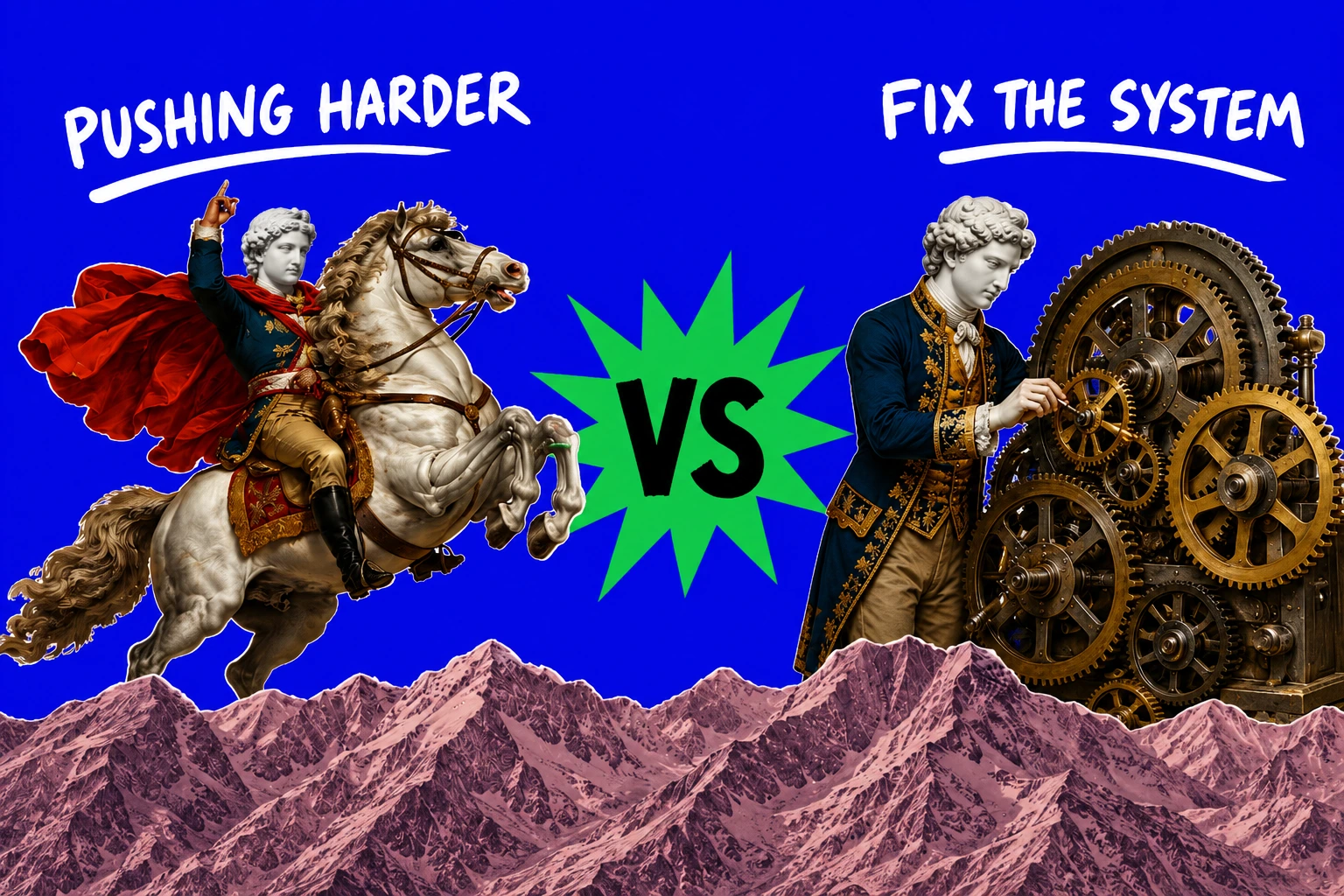

There's a specific kind of tired that founders don't talk about much. It's not the tired from working late. It's the tired that comes from feeling like you are the engine. If you stop pushing, everything coasts to a stop. Every project, every deadline, every deal seems to need you leaning on it or it quietly stalls.
Most founders read that feeling as a motivation problem. The team doesn't care enough. They don't have the ownership. If they just wanted it as much as I do, I wouldn't have to push.
I've run teams, built companies, sat in the executive seat, and made most of the mistakes worth making. The one that cost me the most was about people. And here's what I got wrong for years: I treated "they're not delivering" as a single problem with a single cause, so I reached for a single tool. I pushed harder.
Pushing harder works for exactly one of the three reasons someone underdelivers. For the other two, it makes things worse.
When someone on your team isn't delivering what you expected, there are only three things to check, and they're worth checking in order.
The first is whether they actually understand what you're asking. This one fails in two different ways, and they deserve very different responses.
The first way is on you. If you're asking yourself if you said it once in a meeting, you're doing it wrong. The test is whether the expectation is clear enough that they could repeat it back to you and get it right. This sounds obvious, which is exactly why we skip it. We assume clarity because the thing is clear to us. It lives in our head with all its context. What lands with them is a fraction of that, filtered through everything else they're juggling. A surprising amount of "they're not delivering" is just "we were never actually aligned on what delivering meant." It's the same reason most teams get OKRs wrong: the target is obvious to the person who set it and blurry to everyone expected to hit it.
The second way is harder to admit: sometimes you've been perfectly clear and they still can't see it. A few years ago, our business was under attack on every front, and I needed my head of product management, who was excellent tactically, to start thinking strategically. I coached her for months. She never got it, and we ended up parting ways. Explaining better fixes the first version but does nothing for the second, because the gap isn't in the message anymore. Before you conclude anything about the person, figure out which one you're looking at. One gets fixed with a better brief. The other is a much harder conversation, and it doesn't get easier by postponing it.
The second is whether they have the capability to do it yet. Not the potential eventually. The skill right now. I saw this clearly with a client where we took a team that had spent years on the delivery side and asked them to become a growth and sales team. In sales you can make expectations concrete. Here are the targets. Here's what the process looks like. Here's the positioning. So they understood perfectly what we wanted. They just weren't there yet.
These weren't experienced salespeople we'd hired for the skill. We were asking people to become something different from what they'd been. This gap tends to widen as you scale, which is part of why everything seems to break around 50 employees: the roles outgrow the people faster than anyone plans for.
That gap is not a character flaw. It's a training problem. And if you respond to a training problem by applying pressure, you're punishing someone for not having a skill you never gave them. If you hand a stretch goal to someone who isn't equipped yet and then lean on them when they miss, you're not holding them accountable. You're the one failing, and you set them up for it.
The third is the hardest to say out loud: do they actually want it. Not the title, not the raise. The work itself. This one hides because people rarely turn down a promotion. Someone gets offered a bigger role and takes it, because the money's better or because their ego says they should have a bigger title by now.
They say yes to the package. That isn't the same as wanting the job. And if you watch closely, you can usually feel the difference between someone who wants the work and someone who wanted the offer. When it's the second one, no amount of pushing fixes it, because you're pushing against a person who is quietly hoping this isn't really their job.

Here's why the exhaustion happens. When you push everyone the same way, you're using the one tool that only works for the person who genuinely wants it and just needs a nudge. For the person who doesn't understand, pushing adds pressure to confusion. For the person who isn't capable yet, pushing adds pressure to a gap that only training closes.
So you push, you get a little movement, it fades, and you conclude the team needs you to push again. You've built a machine that runs on your energy, then you wonder why you're the only one carrying it. This is how founders become the bottleneck in their own company: not through one big failure, but through a hundred small moments where pushing felt faster than fixing.
The way out isn't more force. It's diagnosis. Next time something's not moving and your instinct is to lean on it, stop and run the three lenses. Do they understand it? If not, that's on you to make clear. Do they have the skill? If not, that's on you to build or bring in. Do they want it? If not, that's a conversation you've probably been avoiding, and pushing has let you keep avoiding it.
I've screwed up on all three fronts, so this isn't me lecturing from a clean record. It's the thing I wish someone had made me sit with earlier. The goal was never to push harder. It was to stop needing to.
If you're tired of feeling like you're the only one pushing, and everything slows down the moment you take a day off, reach out. I'll help you find the real issue within two weeks. Three months from now, you could have a completely different team.
Check three things, in order. First, do they understand what you're asking, clearly enough to repeat it back? Second, do they have the capability to do it right now, not just the potential? Third, do they actually want the job itself, not just the title or the raise? Each gap needs a different response, and only one of the three is fixed by pushing harder.
Usually because you're applying one tool, pressure, to three different problems. Pushing works on the person who wants the role and just needs a nudge. On someone who doesn't understand the expectation or doesn't have the skill yet, pressure adds stress without adding capability, so the movement fades and you conclude you have to push again. The exhaustion is a diagnosis problem, not a motivation problem.
Look at effort and direction. Someone who lacks skill is usually trying, often visibly, but producing the wrong output or missing the standard. Someone who lacks desire tends to do the minimum, avoids ownership, and shows relief rather than frustration when work slips. Skill gaps close with training and support. A desire gap needs a direct conversation about whether this is really the right role for them.
Only if you pair the stretch goal with real support and training. Handing someone a target they aren't equipped to hit, then leaning on them when they miss, isn't accountability. It's setting them up to fail, and the failure is yours, not theirs. Build the skill first, or bring in help, then raise the bar.
Stop treating every stalled task as a reason to push, and start diagnosing why it stalled. Make expectations explicit, close skill gaps deliberately, and have the honest conversations about fit you've been avoiding. The goal is a team that moves when you're not in the room, so the company no longer runs on your personal energy. If you want help finding the specific issue fast, book a call.